

It would be incredibly useful if we could know what Phytophthora ramorum‘s impact and distribution will be in 10 years, 50 years, and beyond. Where will the pathogen become established? Where could it become established if it was introduced and in what geographic areas and climates would it cause unacceptable damage? To answer these critical questions, several Phytophthora ramorum risk models have been developed for the USA, Canada, and California.
- An overview of P. ramorum disease modeling can be found in Chapter 4 of the Sudden Oak Death and Phytophthora ramorum Literature Summary.
- See a list of the most current modeling efforts.
- Read more about the USDA Animal and Plant Health Inspection Service’s P. ramorum risk model summary.
- See the California and National risk models as presented in 2005 at the USDA Forest Service, Southern Research Station in Asheville, NC.
| Oregon | Predicting potential and actual distribution of sudden oak death in Oregon: Prioritizing landscape contexts for early detection and eradication of disease outbreaks Tomás VáclavÃk, Alan Kanaskie, Everett M. Hansen, Janet L. Ohmann, and Ross K. Meentemeyer |
| National | Koch, Frank H. and William D. Smith. In press. A revised Sudden Oak Death risk map to facilitate national surveys. Chapter 7 in K.M. Potter and B.L.Conkling, eds., Forest Health Monitoring 2009 National Technical Report. General Technical Report SRS-xxx. Asheville, North Carolina: U.S. Department of Agriculture, Forest Service, Southern Research Station.
|
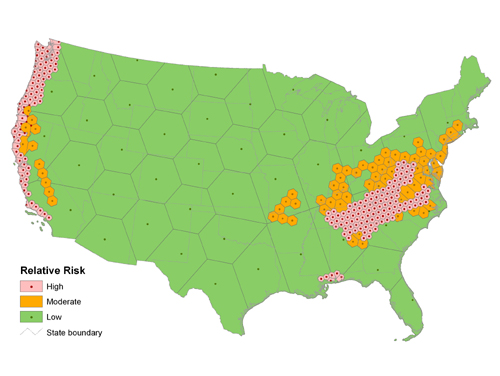
California Risk Models
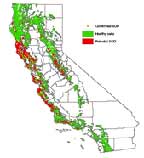 |
Support Vector Machines for Predicting Distribution of Sudden Oak Death in California | Paper (Guo et al., 2004) UC Berkeley |
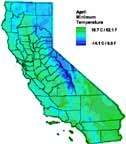 |
Spatial Modeling of P. ramorum in California Information University of N. CarolinaMapping the Risk of Establishment and Spread of Sudden Oak Death in California | Paper (Meetemeyer et al., 2004) Sonoma State University, UC Davis, California Polytechnic State University |
National Risk Models
 |
Climate and Host Mapping of Phytophthora Ramorum (NAPPFAST) | Presentation Fowler and Magarey, 2005 USDA APHIS |
 |
Risk Mapping for Forest Pests | Presentation Gottshalk and Liebhold, 2005 USDA Forest Service |
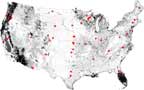 |
Predicting National Susceptibility Patterns for Sudden Oak Death | Presentation Hoffman, Hargrove, Hessburg, and Salter, 2005 USDA Forest Service |
 |
Modeling Risk for SOD Nationwide | Paper (Kelly et al., 2005) USDA Forest Service |
 |
A Refined Approach for Examining Phytopthora ramorum Risk in the Eastern US. | Presentation Koch, 2005 N. Carolina State University |
 |
Hotzone GIS Analysis for Targeting Surveys for Phytopthora ramorum | Paper Magarey, Fowler, and Colunga, 2005 USDA APHIS |
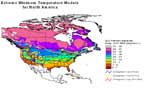 |
Climatic Domain Maps for Sudden Oak Death | Presentation McKenny, Campbell, Hopkin, and Lawrence, 2005 Canadian Forest Service |
 |
National Risk Model for Phytopthora ramorum | Presentation Smith, 2005 USDA Forest Service |
 |
A CLIMEX Model for the potential establishment of P. ramorum in the Eastern US | Presentation Venette, 2005 USDA Forest Service |
 |
Potential Climatic suitability for establishment of P. ramorum within the contiguous United States | Paper Venette & Cohen, 2006 USDA Forest Service |
