

For quick reference, see the following links:
- Photo gallery of plants and symptoms
- Symptom Guide for Nursery Inspections
- Wildland Diagnostic Guide
- Nursery Diagnostic Guide
- Spanish symptom guide for SODBlitz
Diagnosis
Accurate disease diagnosis can be difficult because the symptoms caused by Phytophthora ramorum are very similar to those caused by other fungi, insects, or adverse environmental conditions. The only way to confirm a P. ramorum or Sudden Oak Death infection is to take a sample and analyze the affected plant tissue in a laboratory. There are two published diagnostic guides (Wildland Diagnostic Guide and Nursery Diagnostic Guide) to help you in assessing the likelihood of a P. ramorum infection on a plant and whether to send a sample to the laboratory for a confirmed diagnosis. Photos and descriptions of symptoms caused by other Phytophthora species are assembled here. Our Diagnostic Questionnaire may be helpful as well. If you need additional assistance, connect with a local Contact.
Plant Hosts
The sudden oak death pathogen, Phytophthora ramorum has been identified on well over 100 diverse species of plants; hosts include hardwood and conifer trees, shrubs, herbaceous plants and ferns. On most plant species, symptoms are limited to leaf spots and shoot dieback and are not lethal.
An official list of host plants as of 2022 is maintained by the USDA APHIS as part of the federal quarantine; some additional hosts reported since 2013 are compiled here. For regulatory purposes, hosts are divided into “regulated hosts” or “associated hosts” depending on the amount of testing that has been conducted to demonstrate that the plant species is a host for the pathogen. Additionally some plant species have been confirmed as P. ramorum positive hosts but have not yet been added to the USDA host or associated host list. In all of these cases, symptom photos and regulatory status is noted on the Plant Symptom Photos page.
Photographs of many P. ramorum hosts found in the UK are featured in “Observatree Field Identification Guide, Phytophthora ramorum“. Symptoms photos include Japanese larch, rhododendron, several broadleaf trees and others.
Symptoms
Phytophthora ramorum causes two types of symptoms depending on the host plant. Bole or trunk cankers form on tanoaks and some oaks while most shrubs and non-woody plants show leaf spots which may be accompanied by shoot dieback. Trunk cankers are the most damaging, and often lead to death. Once weaken by P. ramorum, the diseased oak and tanoak trees are often attacked by bark beetles that can hasten mortality. When parts of the tree die, fungi latent in the trees may be stimulated to grow, such as Annulohypoxylon thourasianum. Foliar leaf spot and twig symptoms are lethal only when plants are very small. However, plants with minor symptoms may play an important role in pathogen spread as the pathogen reproduces or sporulates on many of these species. In California, the most important foliar, sporulating host is California bay laurel, Umbellularia californica while in the UK Rhododendron ponticum and Japanese larch (Larix kaempferi) can harbor the pathogen and serve as a reservoir of inoculum.
The “Symptom Gallery” displays symptoms on many forest and horticultural plants. This page describes symptoms on common California hosts.
Oaks (Quercus spp.)
Only oaks in the red or intermediate groups have been found infected – oaks from the white group are not susceptible. Only larger (>10 cm dbh) trees show symptoms; infections of smaller saplings have never been seen in nature. The most obvious and useful symptom to look for on oaks is a canker on the trunk. Cankers have red-brown to black discoloration and seep dark black to red or amber sap. They usually develop 1 to 2 m off of the ground, although they can be at soil level, or as high as 4 m or greater; they do not extend below the soil line. Bleeding sap initially appears on intact bark, absent any obvious holes or wounds, though, in later stages of the disease, the bark may split.

Infections by Phytophthora ramorum on oaks were originally called “Sudden Oak Death” because of the apparent rapid (2 to 4 weeks) browning of leaves throughout the entire crown without a prolonged period of visible decline. While this sudden browning may occur, death of the tree due to P. ramorum infection usually takes place after an extended period of infection, estimated as more than two years. During that time, external symptoms may not be present or may be limited to slight, intermittent oozing that can be difficult to detect. A number of other organisms tend to colonize oaks with P. ramorum infections, including ambrosia beetles (Monarthrum scutellare and M. dentiger), bark beetles (Pseudopityophthorus pubipennis), and a decay fungus, Annulohypoxylon thouarsianum. Though these attacks are secondary to the original P. ramorum infection, they act to further weaken the trunk and may hasten tree mortality.
Tanoak (Notholithocarpus densiflorus)
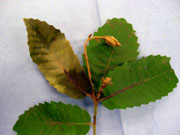
Tanoak is the most susceptible of the known hosts to P. ramorum. All sizes and ages of tanoaks (seedlings, saplings, mature trees) can be infected and killed. Trunks, branches, twigs, leaves, and leaf petioles may become infected and the pathogen can sporulate (reproduce) on tanoak twigs and leaves. Tanoak trees may be infected without showing cankers or bleeding symptoms, which complicates diagnosis. Trunk cankers are similar in appearance to those on species in the red oak group. As with the red oaks, death can occur with a sudden browning of leaves throughout the entire crown, or more slowly with gradual leaf loss. P. ramorum infection in twigs can lead to shoot tip dieback or a shepherd’s crook. Secondary organisms are likely to attack weakened and dying trees. See additional symptoms on tanoak on this handout from the Garbelotto lab at UC Berkeley.
California bay laurel (Oregon myrtle) (Umbellularia californica)
On bay laurel, Phytophthora ramorum causes leaf spots, typically brown to gray leaf tips, with irregular margins, outlined by a yellow halo. Lesions are typically found where water collects on the leaf – generally the leaf tip, though on leaves that are flat or positioned sideways, a leaf spot can develop elsewhere on the leaf. We have not seen any cases of California bay laurel dying due to a P. ramorum infection, but these trees are important reservoirs of inoculum for the pathogen and play a significant role in pathogen spread.
See additional symptoms on California bay laurel on this handout from the Garbelotto lab at UC Berkeley.
Camellia (Camellia spp.)
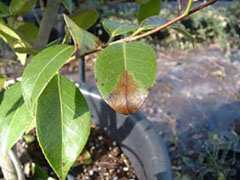
Camellia symptoms are Camellia Leaf. Photo: PHSI Defra, UKtypically limited to leaf spots, which vary in size from less than half a centimeter in diameter to covering nearly half the leaf, depending on environmental conditions. Lesions form on the leaf tip or edge, and may be surrounded by diffuse margins or thick black zone lines. Plants drop infected leaves, causing the lower part of the plant to defoliate. Flower buds may harbor infection without visible symptoms and may be an important source of inoculum for pathogen spread in nurseries.

Rhododendron (Rhododendron spp.)
Leaf spots are the main symptom on rhododendron, though dieback of small branches (shoot blight) also occurs. Lesions extend through the leaf tissue so that spots are identical in size on both the top and bottom of the leaf. They can be elongated, extending along the leaf mid-vein, or may be found where ever water collects on the leaf surface (along edges, near the petiole, and at the leaf tip). Leaf spots have diffuse margins and a water soaked appearance. Rhododendrons, including hybrids may both become infected but some cultivars are more susceptible than others. Root infection of rhododendron plants may occur without visible aboveground symptoms.
